In 2006 when I first got "the opera bug," I made extensive use of online and radio broadcasts to record (to cassette) and hear new operas. Between the Met and WFMT, there is a broadcast nearly every Saturday of the year.
http://www.operainfo.org/ The Metropolitan Opera radio broadcasts, carried by many public radio stations. This site also contains background info on the operas of the current and previous seasons, with score examples, photos, and recording clips.
http://www.metoperafamily.org/stream.aspx
Every week during the Met season (approximately August to May) one performance is streamed live online, through RealPlayer.
http://www.wfmt.com/main.taf?p=12,10 WFMT fills out the year in between Met seasons (May-August), with broadcasts from Chicago and San Francisco's opera houses. Radio coverage can be supplemented by online streams from stations in the WFMT network.
http://www.npr.org/programs/world-of-opera/
Depending on your location, you may hear World of Opera, NPR's opera highlights program. If like me, this is not available to you on air, the website archives "hit singles" and sometimes whole operas.
I will be working on a recurring spotlight on available broadcasts with background on the operas featured.
Tuesday, June 14, 2011


Monday, June 13, 2011
Moondance
We've all heard Van Morrison's jazz tune "Moondance." How do the covers measure up?

The verse is mostly made up of the same A A’ phrase, but Morrison’s feel for the music makes these repeats anything but repetitious. He allows the words to shape the lines in terms of intensity and momentum. Morrison’s voice in this song (both as an instrument and as “author”) is confident and casual, and retains its “rock” timbre while singing convincingly in a jazz style. He sounds like he has the whole night to spend on song and romance, and conveys a laidback yet eager attitude.
Covers for this song are not hard to find, and I heard many of them in between listening to the singers I already knew (Buble, McFerrin, Morrison).
 Reed does a decent job of varying the phrases, but as noted in comments, her decision to drop her voice at the end of each phrase makes the words less than audible. In a song like “Moondance,” attention to little details make the whole piece more passionate – you can’t rush over any words (even repeated sections) and come across convincingly. Also, her choice of timbres for contrast occasionally strike my ear as odd. Reed’s voice becomes big where the song could be interpreted as soft, etc.
 According to Wikipedia (unsourced, unfortunately), Morrison was pleased by Tate’s cover. Tate changes the melody in little ways, making it his own and increasing the intensity, and in general sings a higher-energy “Moondance” than Morrison. In the first verse, the brushes on the drum sound like the leaves Tate, an excellent drummer, mentions in the lyrics.
 McKenzie is called in the caption for this video “the top UK Michael Buble tribute act.” He has a very clean voice; in my opinion his version is way too clean. Every word, even when the song really gets going before the break (2:00), is chopped neatly into place (though the attacks themselves are scooped in a very pop-music style) and the timbre barely varies from the first verse to the end.
 Here’s Buble himself, at the Verizon Wireless Arena of my home state. Singing this live, he brings as polished an approach to the overall song as if he were in the studio. As with Reed, some of his phrases seem “hard” where they could be softer and more tender (such as 3:17 “make some more romance”); this seems to be his way of sounding forcefully romantic or dramatic, not something Buble is known for. Like Tate’s version, he raises the intensity of the song overall from Morrison’s original and it works, especially live.
 This version strikes me as more idiomatic than the Catherine Reed version, though uneven overall. Charlese uses a great variety of vocal color, and patterns the intensity of her phrases on the text like Morrison. Her voice gets breathy at times in an awkward way, but overall she has plenty of feeling and a free but intense approach to the song.
 Saving arguably the best artist for last, here is Bobby McFerrin. Son of an opera singer, he is a consummate musician and sings the “instrumental” solo at the beginning of this track. McFerrin changes the melody right from the beginning and interpolates new wordless solos, while sticking to the low, calm atmosphere of Morrison’s Moondance. Because the repetitive elements (vocal melody, guitar accompaniment, rhythms) in the song are carefully rearranged and varied, McFerrin manages to make his version even more laidback and precisely romantic than Morrison’s. A similar, live version is linked below.

Original version by Van Morrison, with lyrics
The verse is mostly made up of the same A A’ phrase, but Morrison’s feel for the music makes these repeats anything but repetitious. He allows the words to shape the lines in terms of intensity and momentum. Morrison’s voice in this song (both as an instrument and as “author”) is confident and casual, and retains its “rock” timbre while singing convincingly in a jazz style. He sounds like he has the whole night to spend on song and romance, and conveys a laidback yet eager attitude.
Covers for this song are not hard to find, and I heard many of them in between listening to the singers I already knew (Buble, McFerrin, Morrison).
sung by Catherine Reed
sung by Grady Tate
sung by Kai McKenzie
sung by Michael Buble
sung by Charlese
sung by Bobby McFerrin
sung by Bobby McFerrin (recorded live)
in response to "A Gay Girl in Damascus" blog/hoax
When I read the post reporting Amina's disappearance at http://damascusgaygirl.blogspot.com/, I was deeply saddened that the "bad guys" might have won and that her voice might be silenced. But when I heard that Amina was rumored to be a hoax, my feelings of support and solidarity did not change. Whether fictional or not, the voice was authentic and even more importantly, a minority all too often silenced.
I support Tom MacMaster and I hope he finds time one day to write Amina a book. Her story is worth reading and I would gladly buy any such book. Most of all, I support all dissidents who dare to defy parental expectations, state society, and tradition in defense of their own moral compass.
I support Tom MacMaster and I hope he finds time one day to write Amina a book. Her story is worth reading and I would gladly buy any such book. Most of all, I support all dissidents who dare to defy parental expectations, state society, and tradition in defense of their own moral compass.
Sunday, June 12, 2011
Als die Mutter: Songs from my mother
In my life thus far, there has been no greater musical influence than my mother. Her tastes influenced mine, and my strongest interests in music have developed from the starting point of her printed and recorded collections. My interest in opera would not exist were it not for the musicals of Andrew Lloyd Webber and Rodgers and Hammerstein, which I learned to appreciate because of my parents.
Here are 10 tracks from my mother's record collection or songbooks.
Here are 10 tracks from my mother's record collection or songbooks.
- Buffy St. Marie “Universal Soldier.”
- Rodgers and Hammerstein: Waltz from “Carousel”
- The Beatles: “Taxman”
- Patti Lupone: “Don’t Cry for Me, Argentina”
- Willie Nelson: “City of New Orleans”
- Kenny Rogers: “Lucille”
- The Shirelles: “Soldier Boy”
- “Malagueña”
- Palestrina: Jesu Rex Admirabilis
- How Great Thou Art
Saturday, June 11, 2011
Off beat fugues
I love the intersection of classical forms and popular material, whether it’s the use of ABA form in a rock song or Beethoven’s use of opera hits for themes to vary. Here are some fugues composed on modern pop material which I especially enjoy.
 Frank Loesser’s opening number for “Guys and Dolls” starts the show in a quirky and energetic way, giving the same music to three different gamblers praising the virtues of (and betting on) three different horses. The use of fugue here works well and keeps up the momentum of “Runyonland” (the prelude).
 Giovanni Dettori’s fugue has a good YouTube presence, with covers on organ and piano. Here’s the sheet music: http://www.giovannidettori.com/LadyGagaFugue.pdf Dettori states that this is “not strict counterpoint;” I find it interesting that the answer doesn’t start until the countersubject has begun. He uses the fugal form fairly fluently, making a good argument for the validity of pop material in classical garb.
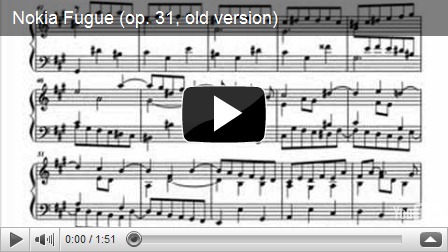 Nokia phones are everywhere, and everywhere they go the subject of this fugue goes with them. http://www.audiomuse.ca/doc/pdf/lo_nokia_fugue_v2a.pdf Vincent Lo, the composer, writes perky counterpoint around this tune (and presents a very clean typeset score, too).
 Now for some professional music. Mana Zucca was a famous soloist and composer around the turn of the century. Look her up online! Shura Cherkassky is another great pianist from later this century and does a fantastic job with this quintessentially American piece. A free recording can be downloaded here: http://www.lykhin.com/eng/classicdb/composers/mana-zucca/1398
.............................................................................................................................................................
Finally, an encore. Though not a fugue, the “Dance of the Hours” from Amilcare Ponchielli’s opera La Gioconda became a popular hit in its day. You may recognize it as another famous pop song: listen to the original (the melody starts at 2:00) and then scroll down for the reveal.


Fugue for the Tinhorns
fugue on “Bad Romance”
Fugue on that ubiquitous Nokia ringtone
Fugato Humoresque on the theme of “Dixie”
.............................................................................................................................................................
Finally, an encore. Though not a fugue, the “Dance of the Hours” from Amilcare Ponchielli’s opera La Gioconda became a popular hit in its day. You may recognize it as another famous pop song: listen to the original (the melody starts at 2:00) and then scroll down for the reveal.
“Dance of the Hours” from La Gioconda
----------------------------------------------------------------------------------------------------------------
----------------------------------------------------------------------------------------------------------------
one of my childhood favorite songs!
Friday, June 10, 2011
Books for summer and beyond
It's summer, and I have more time to read. Here are 27 of the books which I return to over and again, in no particular order, with some quick keywords and Google or Amazon previews when possible. I could write blurbs about all of them, but in most cases the previews explain better than I could. Suffice it to say that what I love most about a book is an author you can connect with, and handsome writing.
Davies, Norman: Europe: a History not so conservative European history
Mumford, Lewis: The City in History
Johnson, Paul: Modern Times conservative American history
Gould, Steven Jay: Wonderful Life on the Burgess Shale fossil deposit
Tolstoy, Leo: Anna Karenina
Hawthorne, Nathaniel: Short Stories try “The Great Stone Face” and “The Wives of the Dead”
Morrison, Samuel Eliot: Old Bruin - life of Matthew C. Perry
Gombrich, E. M.: Little History of the World
Sandburg, Carl: Remembrance Rock nostalgic American epic
Van Loon, Conrad: Van Loon's Lives quirky biography
Dickens, Charles: Dombey and Son
Dawkins, Richard: The Ancestor's Tale evolution in fast rewind
Cozzens, James Gould: By Love Possessed
Russo, Richard: Straight Man college professor humor
Barbery, Muriel: The Elegance of the Hedgehog
Schmitt, Eric Emmanuel: Il Lottatore di Sumo che non diventava grosso *not yet in English that I can find, but well worth the read if you speak Italian.
Atkins, Peter: The Periodic Kingdom chemical geography
McPhee, John: Annals of the Former World *a collection of 5 books* geology and America
Robertson, Don: Praise the Human Season a shared life
Melville, Herman: Moby Dick beautiful words
Conroy, Frank: Body and Soul a musical life
Helprin, Mark: Freddy and Fredericka Charles and Diana
Sobel, Dava: Longitude John Harrison’s chronometer
Livy: Ab Urbe Condita *links to books 1-8, 9-38 also available* nostalgic Roman history
Solzhenitsyn, Alexander: The Cancer Ward humanity
Connolly, John: The Book of Lost Things modern fable
Steve Hely: How I became a famous novelist book humor
Davies, Norman: Europe: a History not so conservative European history
Mumford, Lewis: The City in History
Johnson, Paul: Modern Times conservative American history
Gould, Steven Jay: Wonderful Life on the Burgess Shale fossil deposit
Tolstoy, Leo: Anna Karenina
Hawthorne, Nathaniel: Short Stories try “The Great Stone Face” and “The Wives of the Dead”
Morrison, Samuel Eliot: Old Bruin - life of Matthew C. Perry
Gombrich, E. M.: Little History of the World
Sandburg, Carl: Remembrance Rock nostalgic American epic
Van Loon, Conrad: Van Loon's Lives quirky biography
Dickens, Charles: Dombey and Son
Dawkins, Richard: The Ancestor's Tale evolution in fast rewind
Cozzens, James Gould: By Love Possessed
Russo, Richard: Straight Man college professor humor
Barbery, Muriel: The Elegance of the Hedgehog
Schmitt, Eric Emmanuel: Il Lottatore di Sumo che non diventava grosso *not yet in English that I can find, but well worth the read if you speak Italian.
Atkins, Peter: The Periodic Kingdom chemical geography
McPhee, John: Annals of the Former World *a collection of 5 books* geology and America
Robertson, Don: Praise the Human Season a shared life
Melville, Herman: Moby Dick beautiful words
Conroy, Frank: Body and Soul a musical life
Helprin, Mark: Freddy and Fredericka Charles and Diana
Sobel, Dava: Longitude John Harrison’s chronometer
Livy: Ab Urbe Condita *links to books 1-8, 9-38 also available* nostalgic Roman history
Solzhenitsyn, Alexander: The Cancer Ward humanity
Connolly, John: The Book of Lost Things modern fable
Steve Hely: How I became a famous novelist book humor
Tuesday, June 7, 2011
Concert: Allentown PA
This week I traveled to Allentown, PA to visit family and friends. We went to a recital at St. John's Evangelical Lutheran Church, featuring local organist Stephen Williams and the Monocacy chamber orchestra. This is the program, recreated from YouTube links (not with this ensemble).
Toccata Festiva - Samuel Barber
http://www.youtube.com/watch?v=jC4zz5tP22M&feature=related
Concerto in F - Josef Rheinberger
The Trinity Cathedral is similar to St. John's, though the organ set-up seems larger and more prominent in these videos.
http://www.youtube.com/watch?v=5Xfe_Y-1IJo Movement I
http://www.youtube.com/watch?v=zhrYOZVyQ-Y Movement II
http://www.youtube.com/watch?v=ExT8N4JhmO0 Movement III
Divertimento in D, K.136 - Wolfgang Amadeus Mozart
Tough choice of recordings - the Youth Orchestra of the Americas is represented on YouTube, but the recording is a bit fast for my taste. That recording is here if you want to take a look http://www.youtube.com/watch?v=wXzWjaTCO38 Here is a different recording at a more laid-back pace. http://www.youtube.com/watch?v=eb5d5qQpCdA and the IIIrd movement http://www.youtube.com/watch?v=y447ddkRNM4
Concerto in G minor - Francois Poulenc
http://www.youtube.com/watch?v=3yiq-QcBHXM
Toccata Festiva - Samuel Barber
http://www.youtube.com/watch?v=jC4zz5tP22M&feature=related
Concerto in F - Josef Rheinberger
The Trinity Cathedral is similar to St. John's, though the organ set-up seems larger and more prominent in these videos.
http://www.youtube.com/watch?v=5Xfe_Y-1IJo Movement I
http://www.youtube.com/watch?v=zhrYOZVyQ-Y Movement II
http://www.youtube.com/watch?v=ExT8N4JhmO0 Movement III
Divertimento in D, K.136 - Wolfgang Amadeus Mozart
Tough choice of recordings - the Youth Orchestra of the Americas is represented on YouTube, but the recording is a bit fast for my taste. That recording is here if you want to take a look http://www.youtube.com/watch?v=wXzWjaTCO38 Here is a different recording at a more laid-back pace. http://www.youtube.com/watch?v=eb5d5qQpCdA and the IIIrd movement http://www.youtube.com/watch?v=y447ddkRNM4
Concerto in G minor - Francois Poulenc
http://www.youtube.com/watch?v=3yiq-QcBHXM
Subscribe to:
Posts (Atom)