Showing posts with label musicals. Show all posts
Showing posts with label musicals. Show all posts
Tuesday, July 19, 2011
Musical Theater = that which causes post-play depression
My last gen ed class of college is on a very familiar and special subject for me: Musical Theater. Having grown up on Broadway music and occasionally indulged in the theater bug at the local Village Players Theater, this is a class I love despite the distant aspect of it (like my statistics class, THDA 440 is online this summer). For the first assignment, I had to describe what "musical theater means to me:" which is to say, the dual association of the classic Broadway shows and Andrew Lloyd Webber 1980s hits which my parents enjoyed, and the offshoot of the tradition of opera, my favorite discipline in the arts. My dad was an avid amateur musical actor and some of my earliest memories are of him learning lines, going to rehearsals, and watching “old” musicals on VHS. My start on the stage was with him (Mr. Bumble, in an impressive costume he handmade) in "Oliver!" - my brother and I were 2 of the 3 smallest orphans in the cast, and I learned just how bad I am at choreography and how depressed I get when a show ends! There is something so engaging about working on music, dance, and words collaboratively. The interaction with the material and your fellow actors, not to mention the audience, is compelling and consuming enough to leave a vacant space in your life when it is completed. I probably won't do much musical theater in the future, but the teamwork and the music/words interface are two of "my favorite things."


Prescott Park performance: The Wizard of Oz
This Sunday night I finally saw a Prescott Park Arts Festival musical performance, and the show couldn't be more appropriate. I have always loved every aspect of the 1939 film The Wizard of Oz - the colors, the characters, the music, and how many tiny details became apparent to me with every viewing. Seeing this film recreated as a musical play is a risky business in part because of the numerous details we all love about Oz. Some details like the puff of steam out of the Tin Man's hat (the scariest part of the film for 4-year-old me!) can't easily be recreated in a live performance, and the beloved actors themselves will not be present. Expectations for the live actors, then, are high: they must look and sound enough like the originals not to jar our eyes and ears, but seem authentic on their own merits. Sunday's performance struck a good balance between re-creating the original and reviving the show in an original manner.
Christine Dulong had the "look" of Dorothy, especially at the distance of my table, and her voice was fresh and clean - not at all an affected reproduction of Garland's manner. She is a UNH theater grad and I am very proud! Knate Higgins and Chris Bradley are a bit young for the Scarecrow and Tin Man respectively, if you are comparing them to Ray Bolger and Jack Haley, but in their own right they are good actors and fine dancers, too. Scottie McLaughlin really stood out as the Lion: "tall dark and handsome" with a grand baritone voice and good comedic skills, I hope to see him in many more roles! The older members of the cast were also excellent: Cathy McKay, John Flynn, and Claudia Faulkner as Auntie Em/Glinda, Uncle Henry/Oz/Marvel/etc, and Miss Gulch/The Wicked Witch of the West anchored the show in its many doublings, with plenty of character. Flynn called the winning ticket at the intermission raffle as well - he is an all around showman.
One exciting surprise for me was the sound and orchestral effects. I expected live players in the pit, but because of the excellent sound tech and the versatile keyboards, the pit was represented by a few horns and a keyboard. Many little details of the film were faithfully brought to life through this team's efforts.
Finally, perhaps my favorite aspect of Wizard of Oz: Dorothy's costume (and really, all the principals'). Ms. Dulong had beautiful ruby slippers, and the Scarecrow, Lion, and especially Tin Man sported fantastic costumes and makeup. And Dorothy's dress, black and white gingham in the Kansas scene, became the classic blue when transported to Munchkinland - staying that color for the final scene back in Kansas. I wonder if this was on purpose, to show how Dorothy brought Oz with her?
Christine Dulong had the "look" of Dorothy, especially at the distance of my table, and her voice was fresh and clean - not at all an affected reproduction of Garland's manner. She is a UNH theater grad and I am very proud! Knate Higgins and Chris Bradley are a bit young for the Scarecrow and Tin Man respectively, if you are comparing them to Ray Bolger and Jack Haley, but in their own right they are good actors and fine dancers, too. Scottie McLaughlin really stood out as the Lion: "tall dark and handsome" with a grand baritone voice and good comedic skills, I hope to see him in many more roles! The older members of the cast were also excellent: Cathy McKay, John Flynn, and Claudia Faulkner as Auntie Em/Glinda, Uncle Henry/Oz/Marvel/etc, and Miss Gulch/The Wicked Witch of the West anchored the show in its many doublings, with plenty of character. Flynn called the winning ticket at the intermission raffle as well - he is an all around showman.
One exciting surprise for me was the sound and orchestral effects. I expected live players in the pit, but because of the excellent sound tech and the versatile keyboards, the pit was represented by a few horns and a keyboard. Many little details of the film were faithfully brought to life through this team's efforts.
Finally, perhaps my favorite aspect of Wizard of Oz: Dorothy's costume (and really, all the principals'). Ms. Dulong had beautiful ruby slippers, and the Scarecrow, Lion, and especially Tin Man sported fantastic costumes and makeup. And Dorothy's dress, black and white gingham in the Kansas scene, became the classic blue when transported to Munchkinland - staying that color for the final scene back in Kansas. I wonder if this was on purpose, to show how Dorothy brought Oz with her?
Sunday, June 12, 2011
Als die Mutter: Songs from my mother
In my life thus far, there has been no greater musical influence than my mother. Her tastes influenced mine, and my strongest interests in music have developed from the starting point of her printed and recorded collections. My interest in opera would not exist were it not for the musicals of Andrew Lloyd Webber and Rodgers and Hammerstein, which I learned to appreciate because of my parents.
Here are 10 tracks from my mother's record collection or songbooks.
Here are 10 tracks from my mother's record collection or songbooks.
- Buffy St. Marie “Universal Soldier.”
- Rodgers and Hammerstein: Waltz from “Carousel”
- The Beatles: “Taxman”
- Patti Lupone: “Don’t Cry for Me, Argentina”
- Willie Nelson: “City of New Orleans”
- Kenny Rogers: “Lucille”
- The Shirelles: “Soldier Boy”
- “Malagueña”
- Palestrina: Jesu Rex Admirabilis
- How Great Thou Art
Saturday, June 11, 2011
Off beat fugues
I love the intersection of classical forms and popular material, whether it’s the use of ABA form in a rock song or Beethoven’s use of opera hits for themes to vary. Here are some fugues composed on modern pop material which I especially enjoy.
 Frank Loesser’s opening number for “Guys and Dolls” starts the show in a quirky and energetic way, giving the same music to three different gamblers praising the virtues of (and betting on) three different horses. The use of fugue here works well and keeps up the momentum of “Runyonland” (the prelude).
 Giovanni Dettori’s fugue has a good YouTube presence, with covers on organ and piano. Here’s the sheet music: http://www.giovannidettori.com/LadyGagaFugue.pdf Dettori states that this is “not strict counterpoint;” I find it interesting that the answer doesn’t start until the countersubject has begun. He uses the fugal form fairly fluently, making a good argument for the validity of pop material in classical garb.
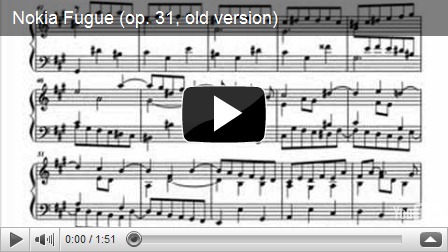 Nokia phones are everywhere, and everywhere they go the subject of this fugue goes with them. http://www.audiomuse.ca/doc/pdf/lo_nokia_fugue_v2a.pdf Vincent Lo, the composer, writes perky counterpoint around this tune (and presents a very clean typeset score, too).
 Now for some professional music. Mana Zucca was a famous soloist and composer around the turn of the century. Look her up online! Shura Cherkassky is another great pianist from later this century and does a fantastic job with this quintessentially American piece. A free recording can be downloaded here: http://www.lykhin.com/eng/classicdb/composers/mana-zucca/1398
.............................................................................................................................................................
Finally, an encore. Though not a fugue, the “Dance of the Hours” from Amilcare Ponchielli’s opera La Gioconda became a popular hit in its day. You may recognize it as another famous pop song: listen to the original (the melody starts at 2:00) and then scroll down for the reveal.


Fugue for the Tinhorns
fugue on “Bad Romance”
Fugue on that ubiquitous Nokia ringtone
Fugato Humoresque on the theme of “Dixie”
.............................................................................................................................................................
Finally, an encore. Though not a fugue, the “Dance of the Hours” from Amilcare Ponchielli’s opera La Gioconda became a popular hit in its day. You may recognize it as another famous pop song: listen to the original (the melody starts at 2:00) and then scroll down for the reveal.
“Dance of the Hours” from La Gioconda
----------------------------------------------------------------------------------------------------------------
----------------------------------------------------------------------------------------------------------------
one of my childhood favorite songs!
Subscribe to:
Posts (Atom)